


Press Release
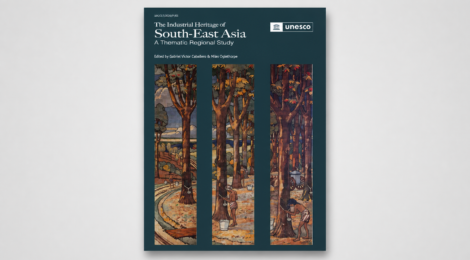
The Industrial Heritage of South-East Asia: A New Regional Study for UNESCO in partnership with TICCIH and ISC20C
A new regional thematic study, The Industrial Heritage of South-East Asia, has been published by UNESCO in collaboration with The International Committee for the Conservation of the Industrial Heritage (TICCIH) and the International Council on Monuments and Sites (ICOMOS) through its International Scientific Committee on Twentieth-Century Heritage (ISC20C).
Carried out by the UNESCO Regional Office in Bangkok with the support of the World Heritage Centre and the UNESCO Regional Office in Jakarta, and undertaken with the active participation of States Parties and distinguished experts across the region, the study responds directly to a gap identified during the Third Cycle of Periodic Reporting for Asia and the Pacific. The resulting Regional Framework Action Plan for Asia and the Pacific (2023–2030), adopted by the World Heritage Committee, called for thematic studies on under-represented heritage themes to help identify future nomination opportunities.
“This study shows how a single thematic exercise can serve several of UNESCO’s Culture Conventions at once. It responds directly to the Regional Framework Action Plan for the Asia and the Pacific adopted by the World Heritage Committee in Riyadh in 2023, helping States Parties in South-East Asia identify and document industrial heritage for their national inventories and Tentative Lists under the 1972 World Heritage Convention. But it has also surfaced a wealth of associated traditions and practices, equally showing the relevance of this heritage category to the 2003 and 2005 Conventions. Just as importantly, it has built a new network of correspondents and expertise across the region: a foundation we can build on for future thematic studies and capacity-building to ensure a balanced, credible and representative World Heritage List.”
JING Feng, Chief of Culture Unit, UNESCO Regional Office in Bangkok
The result is the first coordinated regional inventory of its kind: a broad and inclusive mapping of industrial heritage sites, landscapes and associated practices across South-East Asia. Seventy sites and practices were documented in detail while 700 sites were included in a longer list of important industrial heritage sites and practices in the region. Around a quarter of contributions extended beyond physical sites to intangible traditions linked to industrial heritage, reflecting the diversity, complexity and geographical breadth of the region’s industrial past and its role in shaping economic, technological and social development. The process has also established the roots of a new regional network of industrial heritage correspondents, laying critical groundwork for future initiatives.
The full study is available on the UNESCO website
“The Report marks the beginning of a journey of discovery for many countries in South-East Asia. While some, such as the Philippines, have recognised and documented their industrial heritage for years, the pattern elsewhere is inconsistent, with some countries barely having begun the process. This is reflected in TICCIH’s comparatively weak representation in the region: aside from the 2019 inscription of the Ombilin Coal Mining Heritage of Sawahlunto in Indonesia, no other industrial heritage properties currently feature on the World Heritage List. An especially important outcome of the Report is that it has been a valuable means of building new networks of contacts across the region, while strengthening collaboration with UNESCO and ICOMOS.”
Dr Marion Steiner, President of TICCIH
“This study is a milestone for how twentieth-century heritage is understood in South-East Asia. Industrial sites such as tin mines, textile mills, railways, oil infrastructure and harbour installations are important evidence of the region’s rapid postcolonial industrialisation, shaped by global trade, technology transfer and post-WWII political transformation. Applying the Twentieth-Century Historic Thematic Framework has helped bring this heritage into focus just as its significance is emerging and being defined, contributing to safeguarding it at a critical moment. Too often dismissed as too recent or too utilitarian to warrant heritage recognition, industrial sites like worker housing, power stations and shipyards in fact tell us as much about South-East Asia’s modernisation as any monument, and deserve the same rigour in how we identify, interpret and conserve them.”
Grethe Pontoppidan & Susan Macdonald, Co-Presidents of ISC20C
Download the full text of the joint Press Release UNESCO – TICCIH – ICOMOS ISC20C here