


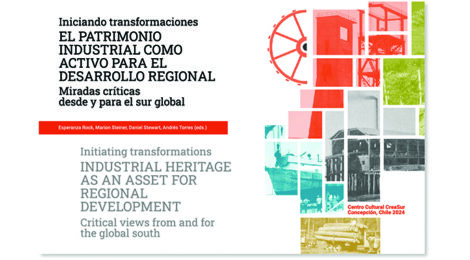
Book – Industrial Heritage as an Asset for Regional Development
Initiating transformations
Industrial Heritage as an Asset for Regional Development
Critical views from and for the global south
Download the Book Here: https://osf.io/by5cr/files/j54an
The CreaSur Cultural Centre in Chiguayante, Chile, thanks to funding from the Regional Development Fund of the Regional Government of Biobío, developed during 2023 the programme “Strategies for the Transformation of Industrial Heritage into Regional Assets”, which positioned the cultural and industrial heritage of the Biobío region as a transformative engine towards regional development and identity.
To this end, CreaSur established fruitful new links between academia, national and international organisations, public service and communities through the IV Congress on International and Interdisciplinary Cultural Heritage, the “Arts in Ruins” Festival and the Diploma Course “Collaborative Methodologies for Heritage Projects with a Critical Approach”. In addition, a Governance Network allowed for the alignment of research and work axes regarding Cultural Heritage in the region.
The book systematically presents the implementation of the Regional Development Programme by CreaSur in collaboration with NUDISUR and TICCIH in 2023 and 2024. The first chapter introduces the different activities of the programme, through which the industrial heritage transformations in the Biobío Region were identified and promoted. The involvement of international human capital had a positive impact on the management of heritage governance.
The second chapter highlights the impact of the IV International and Interdisciplinary Cultural Heritage Congress on “Industrial Heritage: Social Issues and Challenges for New Governance”. This congress served as a strategic point to address current and future challenges in the management of industrial heritage with an emphasis on critical and decolonial approaches in the global North and South.
Diving into the cultural richness of the region, the third chapter highlights the Festival “Arts in Ruins”, an artistic celebration that enhanced the congress, highlighting the valuable intangible heritage of the area, whose narratives provide proposals for the significance of the past.
Finally, the fourth chapter explores in detail the “Diploma in Collaborative Methodologies for Heritage Projects with a Critical Approach,” offering valuable tools and perspectives for effective heritage management.
TICCIH actively participated in the planification and implementation of the programme, its President wrote one of the prologues of the book, and during the congress an Agreement was signed between TICCIH and NUDISUR on future collaborations concerning industrial heritage from a global perspective.
Iniciando transformaciones
El patrimonio industrial como activo para el desarrollo regional
Miradas críticas desde y para el Sur global
Descarga el libro aquí: https://osf.io/by5cr/files/j54an
El Centro Cultural CreaSur en Chiguayante, Chile, gracias al financiamiento del Fondo de Desarrollo Regional del Gobierno Regional del Biobío, desarrolló durante el 2023 el programa “Estrategias para la Transformación del Patrimonio Industrial en Activo Regional”, el cual posicionó al patrimonio cultural e industrial de la región del Biobío como un motor transformador hacia un desarrollo regional e identitario.
Para ello, se establecieron fructíferos nuevos vínculos entre la academia, organizaciones nacionales e internacionales, el servicio público y las comunidades a través del IV Congreso en Patrimonio Cultural Internacional e Interdisciplinario, el Festival “Artes en Ruinas” y el Diplomado “Metodologías Colaborativas para Proyectos Patrimoniales con Enfoque Crítico”. Además, una Red de Gobernanza permitió alinear los ejes de investigación y trabajo respecto al Patrimonio Cultural en la región.
El libro presenta de manera sistemática el trabajo realizado por CreaSur en colaboración con NUDISUR y TICCIH en 2023 y 2024. El primer capítulo presenta las diferentes actividades del programa, gracias a las cuales se identificaron y promovieron las transformaciones del patrimonio industrial en la Región del Biobío. La participación de capital humano internacional tuvo un impacto positivo en la gestión de la gobernanza del patrimonio.
En el segundo capítulo se destaca el impacto del IV Congreso de Patrimonio Cultural Internacional e Interdisciplinario sobre “Patrimonio Industrial: Cuestión Social y Desafíos para la Nueva Gobernanza”. Este congreso sirvió como punto estratégico para abordar los desafíos actuales y futuros en la gestión del patrimonio industrial con énfasis en los enfoques críticos y decoloniales del Norte y Sur global.
Sumergiéndose en la riqueza cultural de la región, el tercer capítulo resalta el Festival de “Artes en Ruinas”, una celebración artística que potenció el congreso, poniendo en relieve el valioso patrimonio inmaterial de la zona, cuyas narrativas dan propuestas de significación del pasado.
Finalmente, en el cuarto capítulo, se explora en detalle el “Diplomado en Metodologías Colaborativas para Proyectos Patrimoniales con Enfoque Crítico,” ofreciendo herramientas y perspectivas para la gestión efectiva del patrimonio.
TICCIH participó activamente en la planificación y ejecución del programa; su Presidente redactó uno de los prólogos del libro y, durante el congreso, se firmó un convenio entre TICCIH y NUDISUR sobre futuras colaboraciones en materia de patrimonio industrial desde una perspectiva global.